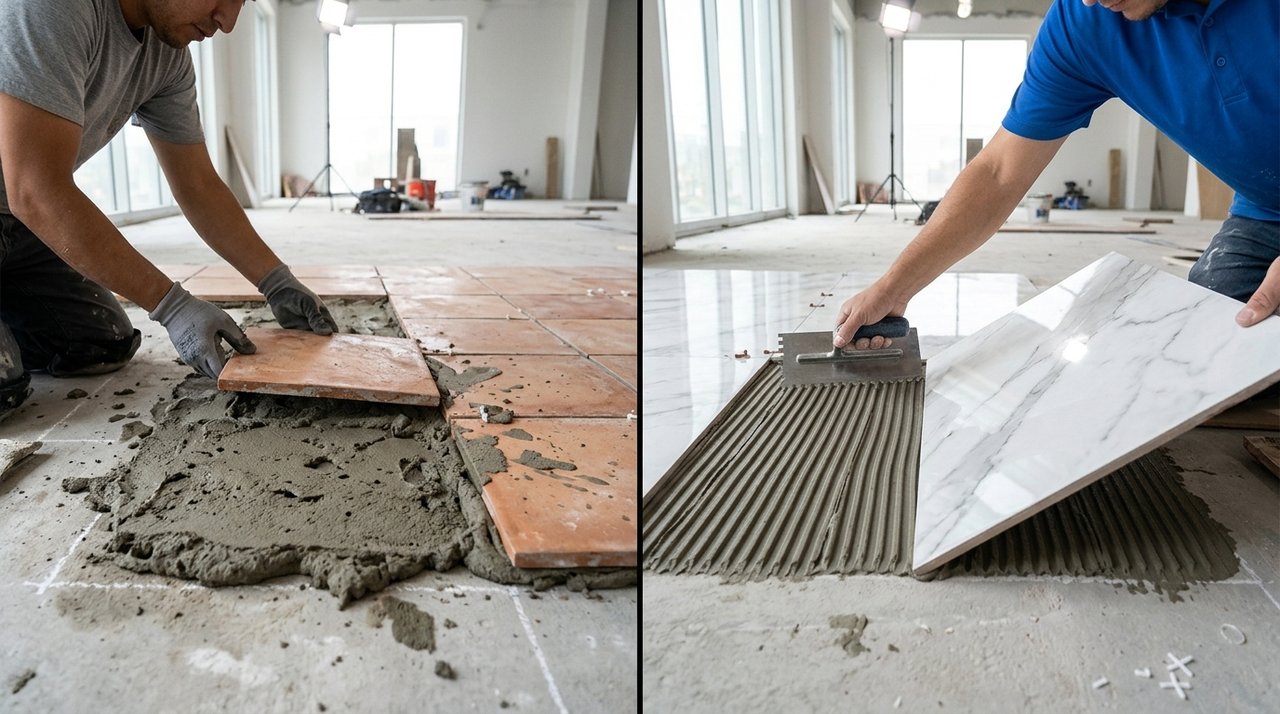
For decades, traditional Portland cement mixed with river sand and water was the default method for fixing tiles in Indian homes. That approach worked in the past primarily because people used small, thick, porous red-body ceramic tiles that naturally absorbed water and allowed cement slurry to anchor inside their pores.
Today, modern architectural designs favor dense, non-porous vitrified tiles, porcelain slabs, granite, and large-format stones. Fixing these modern tiles with traditional cement slurry is the single leading cause of flooring failure, hollow-sounding floors, and catastrophic tile pop-ups.
Below is a comprehensive technical breakdown of why modern tiles require specialized polymer-modified adhesives and how they decisively outperform conventional cement-sand mortar.
Porosity vs. Chemical Bonding
Why Cement Fails:
Traditional cement works purely through mechanical interlocking. When wet cement is applied to a porous ceramic tile, the water and fine cement particles seep into the microscopic pores of the tile back. As it cures, it locks mechanically into place. However, modern vitrified tiles have near-zero porosity (water absorption < 0.5%). Cement simply cannot penetrate the glass-smooth back of a vitrified tile, resulting in zero grip and inevitable debonding.
The Adhesive Advantage:
Gressbond tile adhesives are engineered with specialized redispersible polymers and 100% pure graded quartz silica. Instead of relying on open pores, polymers form a powerful chemical and molecular bridge directly between the dense tile surface and the substrate, delivering high tensile adhesion (2.30 N/mm² in dry condition).
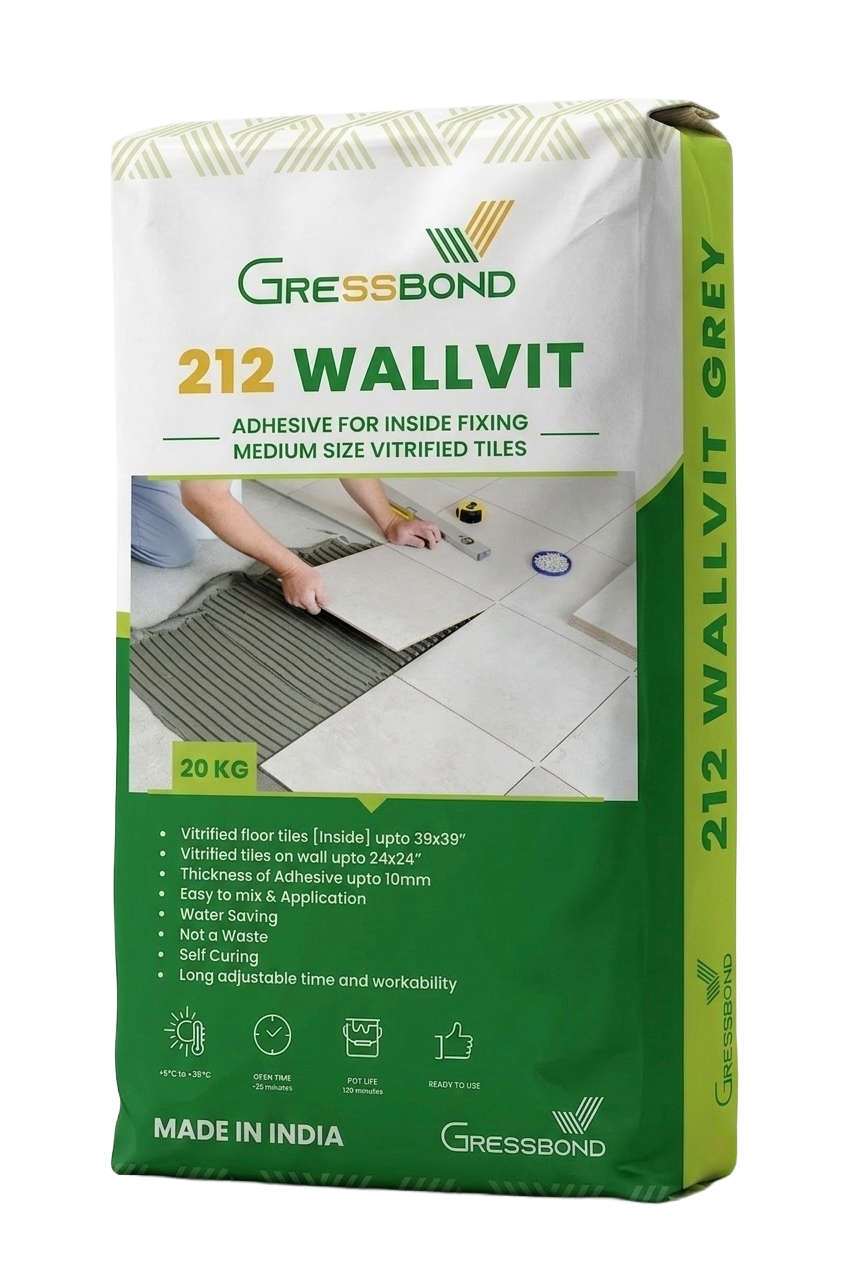
Recommended Solution: Gressbond 212 Wallvit
Specially engineered for dense vitrified tiles on walls and floors. Features high polymer tack that chemically locks non-porous tile backs without needing surface pores.
Shrinkage and Hollow Spaces
Why Cement Fails:
A thick bed of traditional cement-sand mortar (15mm to 25mm) requires an enormous volume of mixing water for workability. As that water evaporates over weeks, the cement bed undergoes severe drying shrinkage. This shrinkage pulls the mortar bed away from the back of the tile, leaving hollow air pockets. When stepped on, the tile produces hollow drum sounds or cracks along stress lines.
The Adhesive Advantage:
Gressbond tile adhesives are applied using the thin-bed method (typically 3mm to 6mm thick) with a notched trowel. Because the formulation retains moisture internally for self-curing and uses strictly graded pure silica without silt or clay impurities, it experiences zero drying shrinkage, maintaining 100% continuous solid contact beneath the tile.
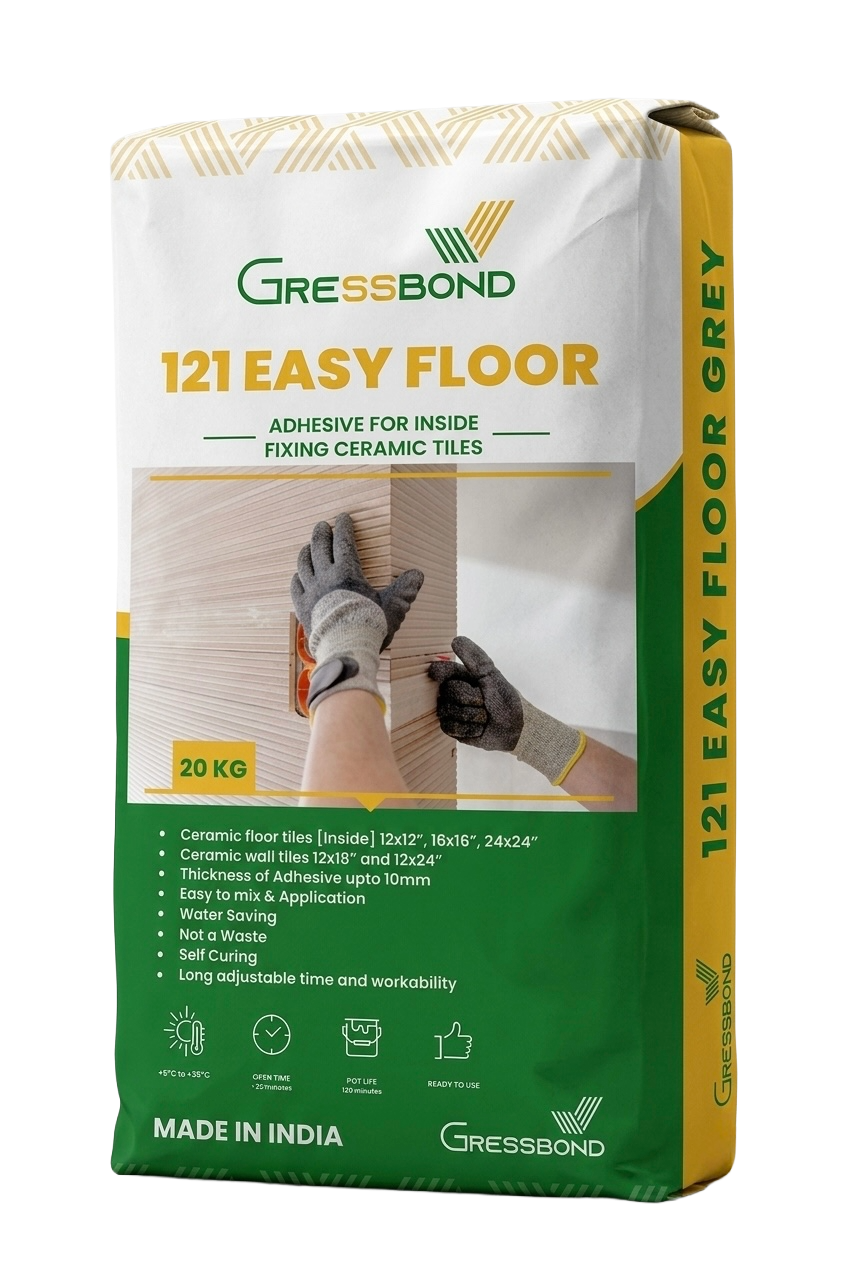
Recommended Solution: Gressbond 121 Easyfloor
Self-curing, thin-bed formulation engineered to eliminate hollow voids completely. Guarantees uniform 3mm to 6mm bed support under regular foot traffic.
Thermal Expansion and Structural Flexibility
Why Cement Fails:
Buildings naturally experience minor structural vibrations, floor deflections, and thermal fluctuations (expanding in summer heat and contracting in winter). Traditional cement cures into a stone-hard, brittle layer with zero flexibility. It cannot absorb structural or thermal movement, transferring all tensile stress directly into the tiles until they crack, buckle, or tent up.
The Adhesive Advantage:
High-performance polymer-modified adhesives possess inherent shear flexibility and deformability. They act as an elastomeric cushion that absorbs thermal shocks and substrate movements effortlessly—proven by superior shear adhesion even under heat-ageing conditions (2.10 N/mm²).
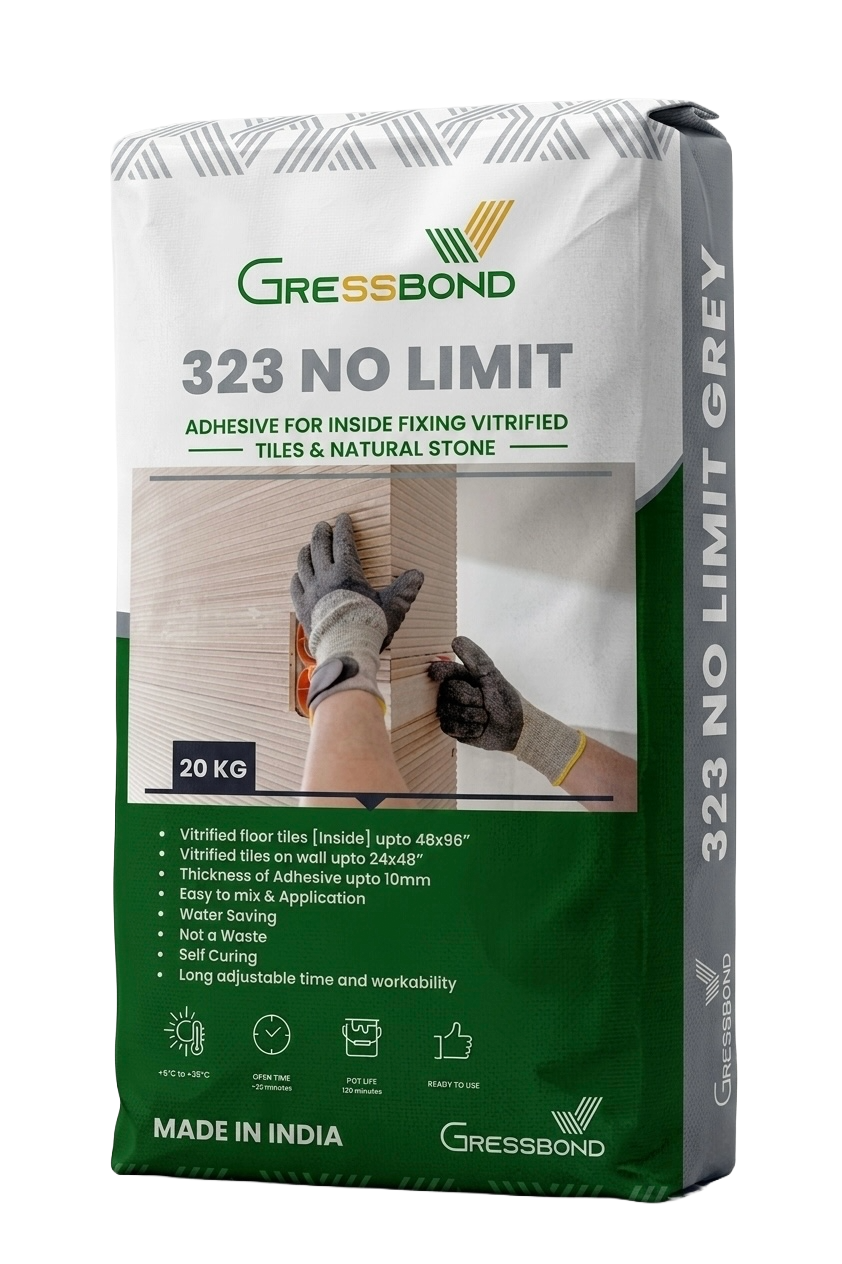
Recommended Solution: Gressbond 323 No Limit (High Deformability)
S1 deformable classification engineered specifically for large-format porcelain slabs, external facades, and vibrating surfaces subjected to extreme thermal cycles.
Time, Labor, and Water Savings
Why Cement Fails:
Traditional cement-sand installation requires pre-soaking tiles in water tanks for 24 hours, manually hauling and sieving tons of sand on-site, applying a messy 25mm mortar bed, and continuously spraying water to cure the area for 7 to 14 days. This is messy, slow, water-intensive, and prone to mixing errors.
The Adhesive Advantage:
Gressbond adhesives are factory pre-mixed single-component powders. You simply add clean water according to the specified water demand (22.50%) and begin tiling immediately—no tile soaking and zero post-installation water curing required. With a generous 45-minute open time and 45-minute adjustment window, masons work twice as fast with zero material wastage. Best of all, the floor is ready for foot traffic in just 24 hours.
Quick Comparison: Traditional Cement vs. Gressbond Tile Adhesive
| Key Feature | Traditional Cement & Sand | Gressbond Tile Adhesive (100% Silica) |
|---|---|---|
| Bonding Mechanism | Mechanical (Needs porous tiles) | Chemical & Polymeric (Bonds to non-porous vitrified tiles) |
| Bed Thickness | 15 mm to 25 mm (Thick-bed, heavy dead-load) | 3 mm to 6 mm (Thin-bed, lightweight) |
| Shrinkage & Cracking | High risk of shrinkage & hollow sounds | Zero shrinkage; uniform 100% bed contact |
| Pre-Soaking / Curing | Requires 24h soaking & days of water curing | No soaking & no post-installation water curing needed |
| Tile-on-Tile Renovation | Impossible (Requires breaking old floor) | Ideal for fixing new tiles directly over old tiles |
| Quality Consistency | Varies wildly by on-site sand quality & mason | Factory-controlled, IS 15477 tested quality |
Upgrading Your Space Without Breaking Old Floors (Tile-on-Tile)
One of the biggest advantages of switching to modern polymer tile adhesives is renovating your home, hotel, or commercial office without the deafening noise, airborne dust, debris disposal costs, and structural wear of breaking down existing floors.
How It Works:
Specialized formulations in the Gressbond range (like 323 Boxen and 323 No Limit) possess high-polymer chemical adhesion that bonds directly onto existing ceramic, polished marble, granite, or mosaic floors. Simply degrease the old surface, comb the adhesive, and fix your new vitrified tiles—saving days of messy demolition.
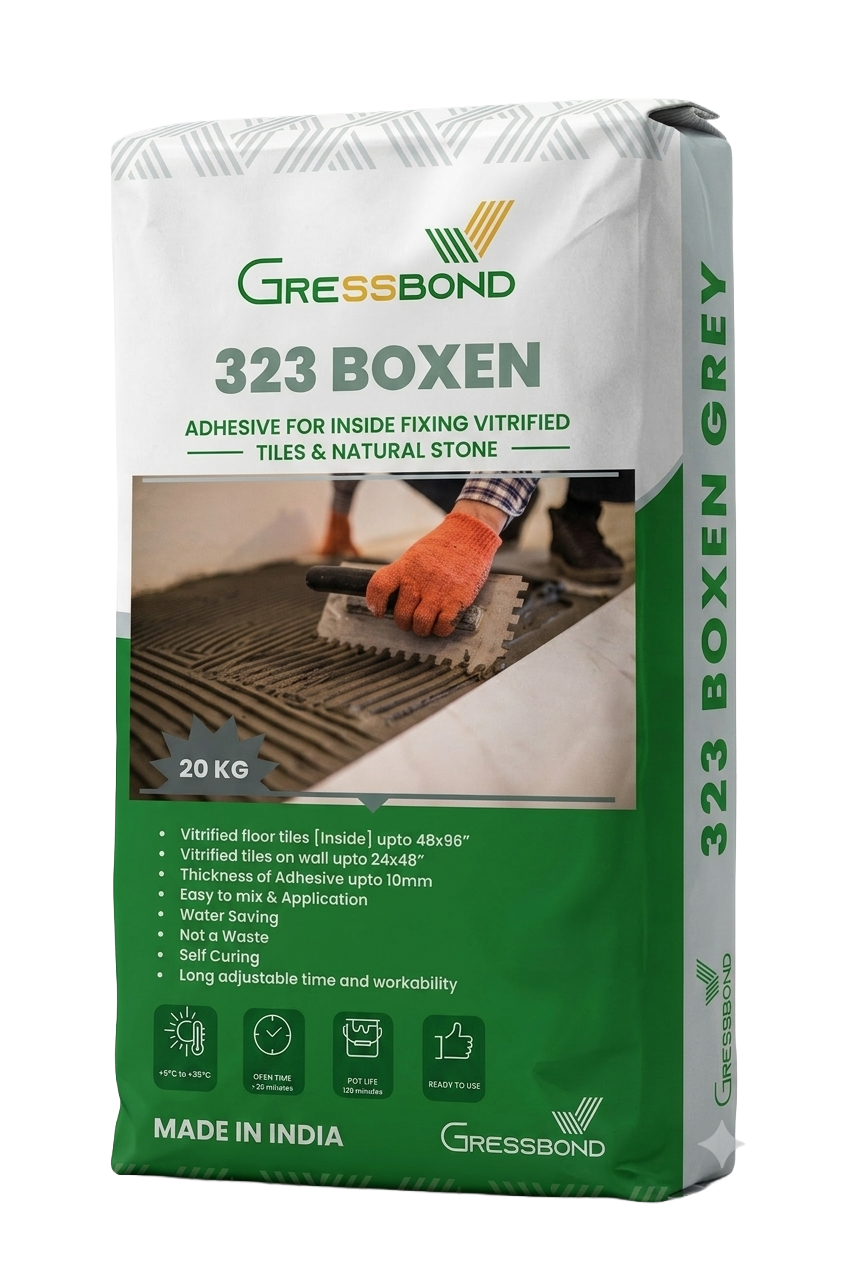
Gressbond 323 Boxen
Premium heavy-duty adhesive engineered specifically for tile-on-tile and natural stone installations.
Upgrade to Certified Bonding for Your Space
Choosing the right bonding material ensures your investment in expensive vitrified tiles and slabs stays locked in place for decades. Pair modern tiles with Gressbond Adhichem’s 100% pure silica-based adhesives.